Catherine's baby has arrived. It's a BOY! He was born on 3-9-10. For photos, details and updates, visit the blog.

Is Cervix Dilation an Early Sign of Labor?

Ultimately, cervix dilation is necessary for labor to progress. If the cervix doesn't open, then the baby can't be born vaginally.


But is cervical dilation necessarily an early sign of labor? No, it's not. A woman can remain 4cm dilated for weeks before true labor begins or can go from no dilation to natural childbirth within a few short hours.


I actually experienced both ends of the spectrum myself. With my first child, I went to my 37 week appointment and found that I was 0cm dilated, 0% effaced and the baby hadn't dropped at all. My doctor said "see you next week, or sooner". I left feeling disheartened only to find that his latter statement was true. I didn't make it to my next appointment. I delivered my first child in a total labor time of 2 hours a few days later.


With my second child, I experienced the polar opposite. I went in for my 34 week appointment to find that I was already 4cm dilated, 50% effaced and the baby was at 0 station. My doctor then warned me we might have a preemie on our hands. However, I made no more progress until the beginning of my 38th week when I delivered her in a total labor time of 45 minutes.


So what information do these two anecdotes provide other than the fact that I have a history of precipitous labor? These examples provide a clear illustration that the degree of cervical dilation prior to the onset of labor is not the best predictor of when true labor will begin. You can make oodles of progress and then just sit there for weeks or go from zero-to-baby in no time.


So as you near the end of your pregnancy and cervix dilation checks begin at your appointments, don't feel overly excited or dismayed. Just feel confident that your baby will come when it is ready.


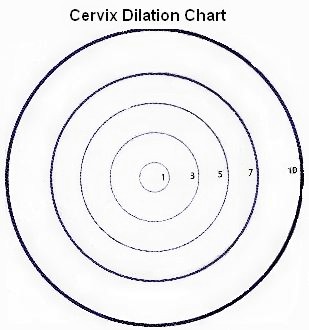
On a different note, many women are confused as to what dilation really means. It can be very hard to visualize so I've included a cervical dilation chart that illustrates the diameter of the cervix opening all the way to 10cms.


Cervical Dilation Chart Many pregnant women also express interest in learning how to check cervical dilation themselves, so here's my step-by-step guide on how to check cervical dilation:

  • Make an appointment with your care provider after 40 weeks 
  • Ask for an internal check

What gives? Never try to check your cervix yourself! It's just too difficult for a lay person, especially a pregnant one to try. Internal checks are a bad idea in general for many reasons.


The first is that you risk introducing infection. The second is that you risk starting premature labor. The third is that internal exams don't tell you much.


While the first two are self-explanatory, let me elaborate a bit on the third. As we've already discussed, cervix dilation itself is not a reliable predictor of when labor will begin. In addition, why are we checking for cervix dilation before a pregnancy has gone full-term. The average duration of pregnancy worldwide is 42 weeks. In the US, doctors get pretty nervous about postdates beyond 41 weeks. I don't recommend internal exams for the above stated reasons until you are potentially facing a postdate induction. Then it can give solid information on how favorable your cervix is for induction.


Giving Birth NaturallyEarly Signs of Labor: Cervix Dilation

Spring Giveaway


Congratulations to Heather Hannah, winner of our Spring Giveaway, a 4 oz jar and sampler pack of CJ's BUTTer, a cloth-diaper friendly rash cream.

 Pregnancy Tickers


Free Pregnancy Tickers

Telecourses


Online Childbirth Classes
Choose 7 week, 12 week, or Self- Paced Online Childbirth Classes...


natural child birth education online

Read our interview with Abby Epstein, Director of The Business of Being Born...


Menu


  StudyWomb™


Newsletter

Email

Name

Then

Don't worry -- your e-mail address is totally secure. I promise to use it only to send you Birthing Blocks.

Online Birth Course

Disclaimer:  All information is provided for informational purposes only, although every effort is made to provide accurate and current information.  Unless otherwise noted, the site content & all online childbirth classes are not written by doctors or other health care professionals and is not intended to be or to substitute for medical advice, diagnosis, or treatment. You should always seek the advice of a physician, nurse, midwife or other health care professional regarding your individual medical questions and any particular medical treatment.

Official PayPal Seal IBCIM.ORG Merchant Seal of Approval