Take the Prodromal Labor Challenge
What is prodromal labor? As you near your due date, you may begin to experience what you think are the beginnings of true labor: contractions, lightening, or loss of the mucus plug. But even though all these signs are in place, you may be experiencing what is termed prodromal or false labor. This has fooled many a woman into a midnight run to her hospital or birthing center. There are, however, some general hints to help you determine whether or not to pack up and go.
Here's a helpful reference chart that contrasts the two:
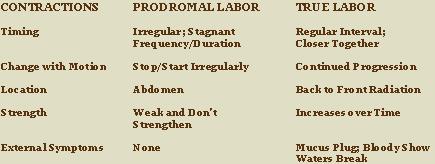
Although they can be difficult to distinguish, it's important to note if the contractions felt are irregular. True labor contractions occur at regular intervals and become more frequent and intense as labor progresses. False labor contractions remain at a steady level of intensity and do not form a regular pattern.
A good test is to engage in a mild form of exercise such as vacuuming or walking. The contractions will tend to fade if it's not really labor, whereas the activity will not affect true contractions. Another important point to note is the location of the contraction. A true contraction tends to radiate from the back to the front as opposed to being located in the abdomen.
Perhaps the best indicator is the co-occurrence of other factors such as bloody show, losing the mucus plug, or the rupture of membranes. There is typically no bloody show or rupture of membranes, although the mucus plug may begin to discharge in false labor.
When in doubt as to whether you are in true labor as opposed to prodromal labor, don't let any fears of embarrassment at being sent home deter you from contacting your care provider or going to your chosen birth place.
Return from Prodromal Labor to Signs of Labor
Return to Giving Birth Naturally Home

Page Last Modified by Catherine Beier, MS, CBE
Most Popular
How to Use Acupressure to Induce Labor
Childbirth Relaxation Script MP3s
Nutrition During Pregnancy - Nix the Notion of Eating for Two
Looking for a Birth Professional? Search our Provider Directory
Follow Us


Online Childbirth Classes
Choose 7 week, 12 week, or Self- Paced online childbirth classes available wherever and whenever you need them.
Featured Birth Story
Vanessa's natural birth story shows that when birth is left alone to proceed as it should, it waits for no one - not even doctors or midwives.
Free Pregnancy Tickers
Create a free pregnancy ticker to post on your blog, website, Facebook profile or favorite social media...
The Birth Survey